Many small businesses in Kerala delay GST filing, thinking it’s just another routine formality. But when deadlines are missed or invoices don’t match, it turns into a costly headache.
For SMEs in Thrissur and across Kerala, staying compliant isn’t just about avoiding penalties — it’s about keeping your business trustworthy, loan-ready, and stress-free.
What is GST and Why It Matters for Small Businesses
GST (Goods and Services Tax) replaced multiple indirect taxes with one unified system.
For small businesses, it simplifies tax management, offers Input Tax Credit (ITC) benefits, and makes interstate trade easier. Filing GST returns regularly also improves your credibility with banks and suppliers — something vital for growing SMEs.
Which Businesses Qualify as Small Businesses under GST
Your GST obligations depend on your annual turnover. Here’s how small businesses are classified:
- Up to ₹20 lakh (₹10 lakh for special category states):
Businesses within this limit are exempt from GST registration, unless they supply goods or services across states or engage in e-commerce. This helps very small traders avoid unnecessary compliance. - Up to ₹1.5 crore:
Such businesses can choose the Composition Scheme, where tax is paid at a fixed lower rate and returns are filed quarterly instead of monthly. It’s ideal for small retailers and restaurants who prefer simple compliance but don’t need to claim input tax credit. - Up to ₹5 crore:
These businesses can opt for the QRMP scheme (Quarterly Return Monthly Payment). It allows them to file returns once every quarter while paying taxes monthly, making cash flow management smoother and reducing filing workload.
For most Thrissur-based traders, service providers, and small manufacturers, this classification helps decide how frequently to file GST returns and what benefits they can avail.
Types of GST Returns for Small Businesses in Kerala
Depending on your business registration type and turnover, these are the main GST returns that small businesses need to file:
GSTR-1
This return reports all your sales (outward supplies) for a given period. It includes invoices issued to customers and helps your buyers claim their input tax credit. Small businesses can file this monthly or quarterly under the QRMP scheme.
GSTR-3B
A short summary return that shows your total sales, tax liability, and the Input Tax Credit (ITC) you’re claiming. This is where you actually pay your GST each month, so it’s one of the most important filings.
GSTR-4
Filed once a year by businesses under the Composition Scheme. It summarises total sales and tax paid at the fixed composition rate, replacing monthly filings for those who choose simpler compliance.
GSTR-9
The annual return that gives a complete summary of all transactions for the financial year. It’s mandatory for regular taxpayers whose turnover exceeds ₹2 crore and helps reconcile yearly data.
Knowing which of these returns applies to your business ensures timely filing and helps avoid common errors or penalties.
Documents to Keep Ready Before Filing
Before logging into the GST portal, prepare the following:
- Sales and purchase invoices (with GSTIN, invoice number, and tax breakup).
- Credit and debit notes, if any.
- Expense vouchers for business-related expenses.
- Bank statements for cross-checking transactions.
- E-way bills, if applicable (for goods movement).
- Updated books of accounts matching your GST reports.
Before logging into the GST portal, prepare the following:
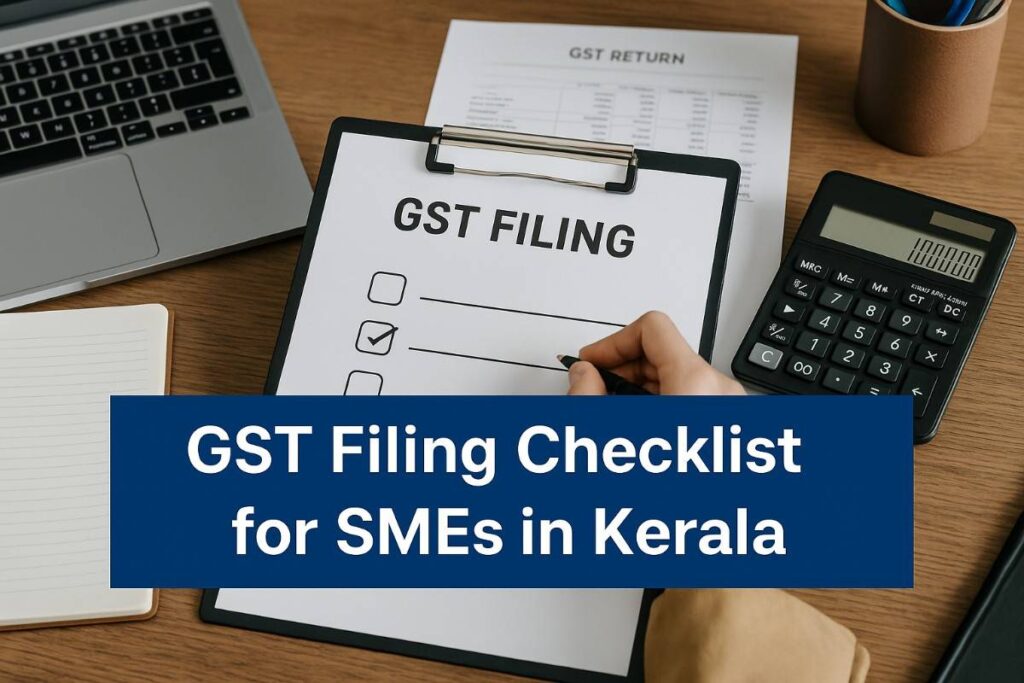
GST Filing Checklist for SMEs in Kerala
Confirm which return you need to file (GSTR-1, GSTR-3B, or GSTR-4):
Make sure you’re filing the correct GST form based on your business type and turnover to avoid compliance errors.
Match purchase data with GSTR-2B — ensure all supplier invoices are uploaded:
Cross-check your purchase records with GSTR-2B to confirm that your suppliers have filed their returns and your eligible input tax credits appear correctly.
Verify outward supplies — check for missing or duplicate invoices:
Ensure that all your sales invoices are included and no invoice has been entered twice, preventing mismatches and penalties.
Review HSN/SAC codes — ensure correct tax rate application:
Double-check that you’ve used the correct product or service codes and applied the right GST rates on each item.
Validate ITC claims — claim only eligible credits reflected in GSTR-2B:
Claim input tax credit only for verified and eligible purchases that appear in your GSTR-2B report to stay compliant.
Pay tax dues before filing — confirm challan payments reflect correctly:
Settle any pending GST payments and make sure the payment details are visible in your GST portal before submitting your return.
Preview and cross-check summary before final submission:
Use the preview option to review totals, tax liabilities, and ITC claims before final filing to catch any last-minute errors.
Download and store filed acknowledgments (ARN receipts) for records:
Save a copy of the acknowledgment number and filed returns for future audits or reference.
Expert Tip
Always keep a digital backup of your invoices, challans, and filed returns. Having these records organized can make audits smoother and help resolve any vendor mismatches quickly.
Consequences of Not Filing GST on Time
Skipping or delaying your GST returns can become costly and affect your business reputation. Here’s what can happen if you miss deadlines:
- Late Fees: A delay in filing GST returns attracts a late fee of ₹50 per day (₹25 each under CGST and SGST), or ₹20 per day for NIL returns. These small daily amounts can quickly add up if the return is delayed for weeks or months.
- Interest on Unpaid Tax: If you don’t pay your GST on time, an interest of 18% per year is charged on the pending tax amount, increasing your total liability over time.
- Blocked Input Tax Credit (ITC): When your returns are not filed or don’t match with your supplier’s data, your input tax credit may get blocked — meaning you lose the benefit of claiming tax already paid on your purchases.
- E-way Bill Restrictions: Businesses that fail to file returns for consecutive months are restricted from generating new e-way bills, which can halt the movement of goods and affect daily operations.
- Legal Action or Suspension: Continuous default or non-filing can lead to official notices from the GST department, penalties under the CGST Act, and even temporary suspension or cancellation of your GST registration.
For many small businesses in Kerala, filing GST on time not only avoids these issues but also helps maintain a clean compliance record, which boosts credibility with banks and suppliers.
How to File GST Easily
Here’s a simplified filing process for small businesses to complete their GST returns efficiently:
- Log in to www.gst.gov.in.
- Go to Services → Returns → Returns Dashboard.
- Select the desired period (month or quarter).
- Prepare GSTR-1: Enter your sales details or upload invoices for the selected period.
- Prepare GSTR-3B: Review total turnover, Input Tax Credit (ITC), and tax payable.
- Make payment: Generate and pay challan using PMT-06.
- File return: Submit using EVC (OTP) or DSC (digital signature).
- Save ARN: Keep a copy of the Acknowledgment Reference Number (ARN) for your records.
If you’re under the Composition Scheme, file CMP-08 quarterly and GSTR-4 annually to stay compliant.
Common Filing Mistakes to Avoid
Even small mistakes in GST filing can lead to penalties or mismatches later. Here are some common errors that small business owners should be careful about:
Claiming ITC on ineligible purchases:
Avoid claiming Input Tax Credit for expenses that are not related to your business — such as personal purchases, entertainment costs, or blocked credits under GST rules.
Forgetting to reconcile GSTR-1 and GSTR-3B data:
Always cross-check that the sales details you entered in GSTR-1 match the summary filed in GSTR-3B. Mismatches between these two forms often lead to notices or audits.
Using wrong HSN or SAC codes:
Applying the incorrect product or service code can result in wrong tax rates being applied, leading to errors in both your returns and your customers’ filings.
Missing NIL return filings when inactive:
Even if your business had no transactions in a month, you must still file a NIL return. Skipping this step can invite late fees and affect your compliance record.
Ignoring supplier compliance:
If your vendors fail to file their returns, your eligible Input Tax Credit may not reflect in GSTR-2B. Regularly check supplier compliance to avoid ITC loss.
Being proactive with these checks helps you avoid penalties, maintain smooth filing, and build a strong compliance record that benefits your business in the long run.
Conclusion:
For many small businesses across Kerala, GST registration & return filing often feels confusing – from managing invoices to understanding which return to file and when. But compliance doesn’t have to be stressful. With the right guidance and a simple checklist, you can stay on top of your filings, avoid penalties, and focus on running your business instead of worrying about tax notices.
At Tony & Iby Global Solutions, Thrissur, we specialize in helping small and medium businesses handle their GST filings with accuracy and confidence. Our team of experienced accountants and tax professionals ensures every return is verified, error-free, and filed on time. With decades of local expertise and a reputation built on trust, we’ve become the go-to firm for businesses in Thrissur that want reliable, transparent, and hassle-free GST compliance support.