Quick Answer
The most common GST filing errors include mismatches between GSTR-1 and GSTR-3B, claiming ineligible Input Tax Credit (ITC) without checking GSTR-2B, filing returns late (attracting late fees + 18% interest), incorrect HSN/SAC codes, and ignoring Reverse Charge Mechanism (RCM) liabilities. To avoid these, implement a strict monthly reconciliation process, automate invoice validation, and never ignore portal notices.
Why GST Filing Errors Are More Common (and Costlier) Than You Think
Problem
For many small business owners, freelancers, and accounts executives in India, the monthly GST filing cycle feels like walking a tightrope. Between navigating the GST portal, tracking diverse invoices, and keeping up with changing notifications, mistakes aren't just possible—they are probable.
Promise
However, getting hit with a DRC-01C notice or finding your Input Tax Credit (ITC) blocked isn't inevitable. Most "complex" GST problems stem from seven simple, recurring errors. If you can identify these pitfalls, you can avoid them entirely.
Proof
The cost of a "small oversight" is real. A simple delay costs you late fees daily, plus 18% interest p.a. on unpaid tax. Worse, a mismatch between your returns can lead to your customers being denied their credit, damaging your business reputation.
Proposal
In this guide, we strip away the legal jargon. We will walk you through the top 7 GST filing errors impacting Indian SMEs today and provide you with a "Show, Don't Tell" practical framework to fix them before they trigger a notice.
1. Missing Filing Deadlines or Filing Returns Late
GST deadlines are rigid. In the eyes of the GSTN (GST Network), even a one-day delay flags your GSTIN as non-compliant, triggering a domino effect of financial and operational consequences.
- Financial Drain: You pay a late fee (typically ₹50/day for regular, ₹20/day for NIL) plus 18% interest per annum on the tax due.
- The Blocking Effect: You cannot file the current month’s GSTR-3B if the previous month’s GSTR-1 isn’t filed.
- Logistics Nightmare: If you fail to file GSTR-3B for two consecutive periods, your ability to generate E-Way Bills is blocked, effectively stopping your goods movement.
💡
Pro Tip: The NIL Return Myth
Misconception: “I had no sales this month, so I don’t need to do anything.”
Reality: You must file a NIL GSTR-1 and GSTR-3B. Failing to do so will still attract late fees and ruin your compliance score.
How to Avoid This Error (Practical Steps):
1
2
3
2. Incorrect Input Tax Credit (ITC) Claims & Neglecting GSTR-2B
Incorrect ITC claims are the single biggest reason for GST scrutiny notices today. The days of claiming ITC based solely on your purchase invoices are over; the GST portal’s data is the ultimate authority.
!
The Trap
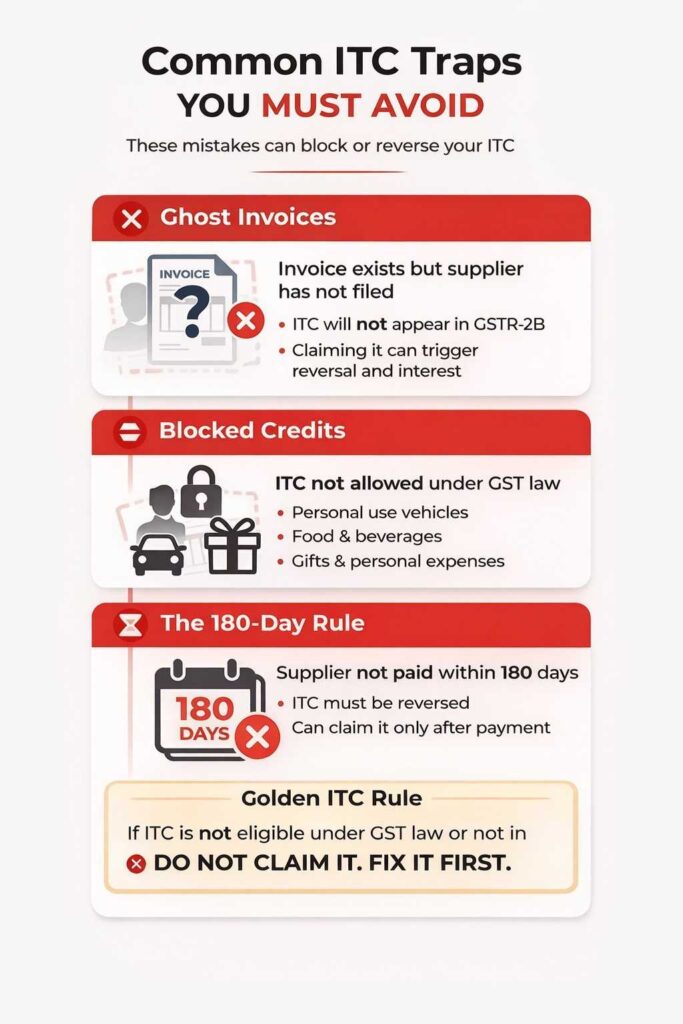
- Ghost Invoices: Claiming credit for an invoice that your supplier hasn’t uploaded to their GSTR-1.
- Blocked Credits: Claiming ITC on expenses listed under Section 17(5) (e.g., food for staff, personal use cars, gifts).
- The 180-Day Rule: If you don’t pay your supplier within 180 days of the invoice date, you must reverse the ITC you claimed, along with interest.

Warning: GSTR-2A vs. GSTR-2B
Stop using GSTR-2A for filing.
GSTR-2B is the static statement that determines your ITC eligibility for the specific month.
How to Avoid This Error (Practical Steps):
1
2
3
Know Your Blocked Credits:
- Motor vehicles (seating capacity < 13).
- Food, beverages, and outdoor catering.
- Goods lost, stolen, or written off.
- Personal consumption items.
3. Mismatch Between GSTR-1 and GSTR-3B
This is the most common trigger for the dreaded DRC-01C notice.
!
The Scenario:
You report ₹10 Lakhs sales in GSTR-1 (Outward Supplies) but only pay tax on ₹9 Lakhs in GSTR-3B due to a calculation error or a missed invoice.
The Consequence:
The system automatically flags this discrepancy. You will receive an intimation requiring you to either pay the difference with interest or explain the mismatch within 7 days.
How to Avoid This Error (Practical Steps):
1
2
The “Pre-Filing” Match:
- Step A: File GSTR-1.
- Step B: Let the system auto-populate GSTR-3B.
- Step C: Verify that the auto-populated figures match your books exactly. If they don’t, investigate before submitting.
3
4. Incorrect Invoice Details and HSN/SAC Classification Errors
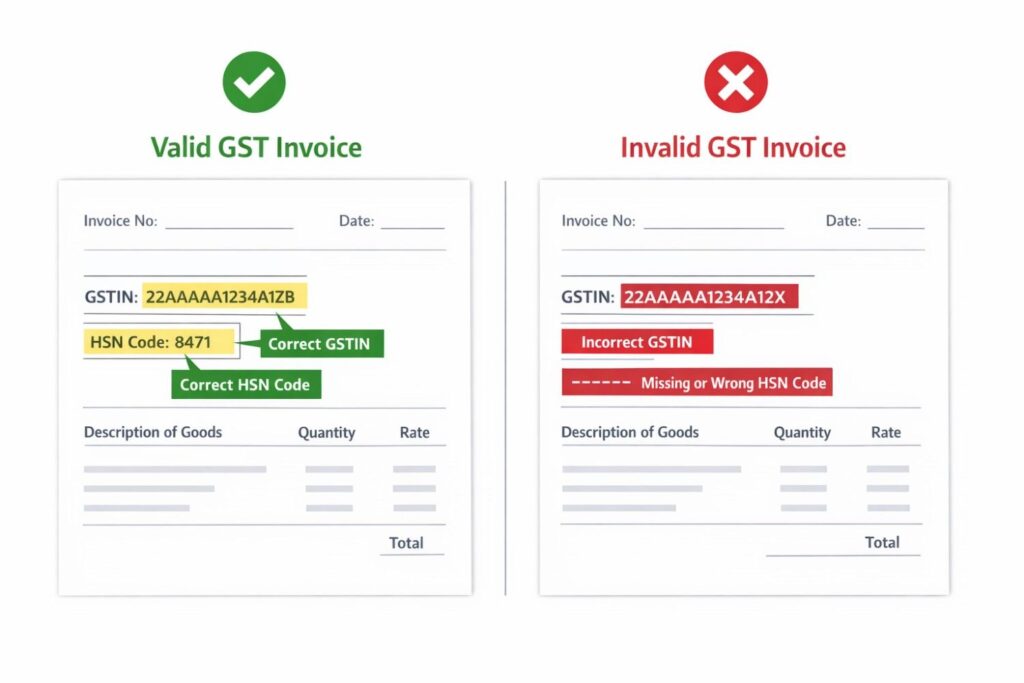
A typo in a GSTIN or a wrong HSN code might look small, but it breaks the digital chain of credit.
!
The Consequence:
- Buyer Denied Credit: If you enter the wrong GSTIN, your buyer won’t see the invoice in their GSTR-2B and will deny you payment.
- Wrong Tax Rate: Using an incorrect HSN code can lead to paying 12% tax on an item that requires 18%, leading to short-payment penalties.
How to Avoid This Error (Practical Steps):
1
2
3
5. Ignoring Reverse Charge Mechanism (RCM) Obligations
The Oversight: Many small businesses assume GST is only about collecting tax on sales. They forget that for certain expenses, they must pay the tax on behalf of the supplier.
!
Common RCM Scenarios
:
- Goods Transport Agency (GTA) services.
- Legal services from Advocates/Firms.
- Security services (in specific cases).
- Purchases from unregistered dealers (for specific notified goods).
The “Cash Trap”:
You generally cannot use your ITC balance to pay RCM liability. You must pay RCM in cash, and then you can claim it back as ITC in the same month.
How to Avoid This Error (Practical Steps):
1
2
3
6. Ignoring GST Notices or Delaying Responses
The “Ostrich Approach” (burying your head in the sand) is dangerous. GST notices are now delivered via email and the portal, and “I didn’t see it” is not a valid legal defense.
!
Why It’s Critical:
- Notices like ASMT-10 (Scrutiny) or DRC-01 require time-bound responses.
- Delaying a response can lead to an ex-parte order (where the officer decides your tax liability without hearing your side) and freezing of bank accounts.
How to Avoid This Error (Practical Steps):
1
2
3
7. Incorrect Tax Head Utilization (IGST, CGST, SGST)
!
The Issue:
If you pay CGST+SGST (Intra-state) for a transaction that was actually IGST (Inter-state), the government considers the IGST unpaid.
Result:
You must pay the IGST (again) and then file a refund claim for the wrongly paid CGST+SGST. This blocks your working capital for months.
How to Avoid This Error (Practical Steps):
1
2
3
Paying the right amount of tax under the wrong head is a cash flow disaster.
Frequently Asked Questions on GST Filing Errors
Can a GST return be revised after filing?
No, the current GST system does not allow you to revise a GSTR-1 or GSTR-3B once it is filed. However, you can rectify errors in the subsequent month’s return. For example, if you missed an invoice in January, you can add it in February’s GSTR-1. If you made a mistake in values, you can issue a Credit/Debit note or amend the invoice details in the next return.
Is a late fee applicable even if I have no business (NIL return)?
Yes. The late fee is applicable for NIL returns as well. Currently, it is generally capped at lower rates (e.g., ₹20 per day) for NIL returns, but it still accumulates and must be paid before you can file the next return.
Why did I get a notice even though I filed my returns?
Filing isn’t enough; the data must match. You likely received a notice because of:
- Mismatch between GSTR-1 and GSTR-3B liability.
- Excess ITC claimed in GSTR-3B compared to GSTR-2B.
- Discrepancies found during data analytics by the tax department.
When Should You Seek Professional Help for GST Compliance?
While many small business owners in India prefer the DIY route to save costs, there is a tipping point where the risk of error outweighs the cost of professional fees.
Consider hiring a CA or GST expert if:
Complex Service Industries
You are in a service industry with complex RCM rules (e.g., Construction, Logistics).
Received ASMT-10 Notice
You have received an ASMT-10 notice. This requires a legally drafted reply.
Turnover Above ₹1.5 Crores
Your turnover has crossed ₹1.5 Crores. The compliance burden increases significantly here.
Complex Place of Supply
You are confused about "Place of Supply." Especially if you sell digital services or ship goods across India.
For business owners in Kerala and South India:
Regional tax consultants are often well-versed in local trade nuances and can provide support that generic online tutorials cannot. If you are spending more time fixing GST errors than selling your product, it's time to outsource.
Practical Checklist for Error-Free GST Filing
Copy and paste this checklist for your monthly accounting cycle:
- Pre-Filing
- Collect all Purchase Invoices.
- Identify RCM vouchers and liability.
- Verify HSN codes on Sales Invoices.
- Crucial: Reconcile Purchase Register with GSTR-2B.
- During Filing
- File GSTR-1.
- Wait for GSTR-2B generation (14th of the month).
- Auto-populate GSTR-3B.
- Crucial: Match GSTR-3B liability with GSTR-1.
- Check Cash Ledger balance for RCM payments.
- Post-Filing
- Download filed GSTR-1 and GSTR-3B PDFs.
- Send "Missing Invoice" emails to suppliers who didn't appear in GSTR-2B.
- Check the "View Notices" tab on the portal.
Conclusion: Discipline is Your Best Defense
Getting GST compliance right isn’t about knowing every section of the law; it’s about discipline, diligence, and review. Most penalties in India are triggered by simple data entry errors or missed due dates.
By automating your calendar, religiously reconciling your GSTR-2B, and treating the GST portal notices with urgency, you can bulletproof your business against costly fines.
Ready to streamline your GST?
Start by implementing the "Internal Cut-Off" calendar mentioned in Error #1 today!
Need Help With GST Compliance in Kerala?
Tony & Iby provides comprehensive GST compliance services for businesses in Thrissur and across Kerala. From monthly filing to notice management, we ensure your GST compliance is error-free and stress-free.
About the Author
Tony & Iby GST Team
With 30+ years of experience in taxation and GST compliance services across Kerala. Specializing in helping Thrissur businesses navigate GST complexities and avoid costly errors.